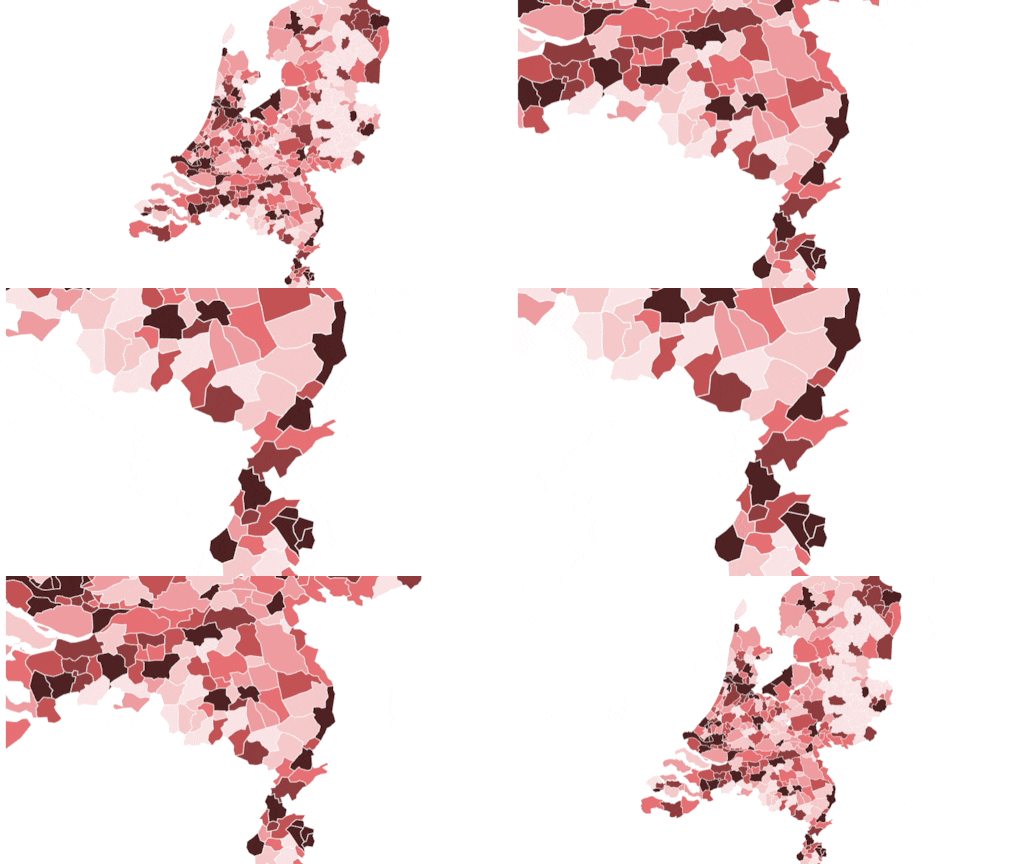
The Netherlands, a nation often lauded for its openness and progressive policies, grapples with a hidden adversary: organized crime. This insidious force, known in Dutch as ondermijning or criminal subversion, erodes the fabric of society by infiltrating legitimate businesses, corrupting individuals, and exploiting vulnerabilities. To shine a light on this opaque problem, RTL Nieuws launched its groundbreaking "Onderwereldkaart" (Underworld Map). This ambitious initiative sought to quantify and visualize the susceptibility of Dutch municipalities to criminal influence, offering an unprecedented look at where the risks are highest. However, as with any pioneering data visualization project, the Dutch Underworld Map: Unmasking Hidden Crime Vulnerability has ignited considerable debate. While praised for its noble intentions and innovative approach, questions have been raised regarding the methodology, the interpretation of its findings, and whether RTL Nieuws' crime risk data might be flawed in its current presentation.
Unmasking the Invisible: What is the Onderwereldkaart Nederland?
In a monumental effort to expose the often-invisible threat of criminal subversion, RTL Nieuws, in collaboration with leading criminologists and experts, undertook a comprehensive study across all 352 Dutch municipalities. The result was the Onderwereldkaart Nederland, an interactive tool designed to illustrate the varying degrees of vulnerability experienced by local governments, businesses, and residents to organized crime. The core objective was clear: to empower communities to recognize the signals of criminal infiltration and enable municipalities to better understand their standing in the fight against crime.
To achieve this, researchers meticulously identified 20 key indicators, chosen for their ability to offer insights into potential risk factors. These indicators ranged from seemingly innocuous metrics like commercial property vacancies and household debt levels to more direct signs such as reported instances of arms trading or the number of residents suspected of subversion-related offenses. The premise was that these factors, collectively, paint a picture of a community's susceptibility, even if direct criminal activity isn't immediately apparent. For instance, high vacancy rates in commercial districts can be a red flag for potential money laundering operations, while widespread problematic debt among residents might make individuals more vulnerable to recruitment by criminal organizations.
The initial findings generated significant discussion. Take the municipality of Geldrop-Mierlo, which found itself ranked 53rd out of 352. This is a concerning position, as communities naturally prefer to be much lower on such a list. Specific data points revealed that in the first ten months of the year, police registered 43 cases of arms trading, placing the municipality 69th in that particular category. Furthermore, a troubling 6% of its inhabitants struggled with problematic debts. In terms of residents suspected of subversion-related offenses, Geldrop-Mierlo also ranked poorly, holding the 29th position. These statistics, according to the map's creators, highlighted localized weaknesses that could be exploited by criminal networks, providing concrete data for local authorities to act upon. Such insights are invaluable for understanding Organized Crime in Dutch Municipalities: Indicators & Impact.
The Double-Edged Sword: Praising the Effort, Questioning the Execution
The ambition behind the Onderwereldkaart Nederland is undeniably commendable. RTL Nieuws' research team deserves credit for tackling such a complex and often taboo subject. Their commitment to utilizing a diverse array of open-source data, consulting with experts from various disciplines, and presenting findings through engaging interactive maps represents a significant leap forward in public awareness and data journalism. The initial impact was profound, drawing reactions from municipal leaders, the national police force, and even the Minister of Justice and Security – a testament to its perceived importance.
However, beneath the surface of this innovative approach lies a critical question: is the map, in its current form, truly achieving its intended purpose without inadvertently causing misinterpretations or undue alarm? Experts have argued that while the effort is laudable, the execution presents certain challenges. A crucial distinction often gets blurred: the map is designed to measure vulnerability to criminal subversion, not the actual prevalence of crime. A high score signifies a higher risk of criminal activity and infiltration compared to municipalities with lower scores, not necessarily that crime is rampant there. This subtle but vital difference can be easily lost in public discourse, potentially leading to stigmatization of communities or an inaccurate perception of local safety.
For instance, an area with high unemployment and low social cohesion might score high on vulnerability indicators. While these are legitimate concerns that criminals might exploit, they are also deeply rooted socio-economic issues that predate and extend beyond organized crime. Attributing a high "underworld" score primarily to these factors without careful qualification risks misdirecting resources or creating an unfair public image. The challenge lies in communicating these nuances effectively, ensuring that municipalities and citizens interpret the data as a call for proactive risk mitigation rather than a definitive statement on current criminal dominance.
Diving Deeper into the Data: Indicators and Interpretations
The effectiveness of any data-driven assessment hinges on the quality and relevance of its indicators. While the 20 chosen indicators for the Onderwereldkaart Nederland were selected with expert input, their interpretation and weighting can be a point of contention. For example, while vacant commercial properties can indeed be exploited for money laundering, they can also be a symptom of broader economic decline or shifting retail trends. Similarly, problematic household debts can indicate socio-economic hardship, which *can* make individuals vulnerable, but it's not a direct measure of criminal presence. The risk lies in oversimplifying complex social phenomena and directly correlating them to criminal vulnerability without sufficient contextualization.
Another point of discussion revolves around how these indicators are balanced. Do all 20 indicators carry equal weight? How are they aggregated to produce a single vulnerability score? Without transparency in the weighting methodology, it becomes difficult for external parties to fully scrutinize the model's robustness. Furthermore, the map reveals interesting spatial differences: indicators like arms trading and vulnerable youth are more prevalent in urban settings, suggesting city-specific challenges. Conversely, drug suspects in smaller communities often share family ties, indicating a more entrenched, localized form of criminal networking. These distinct patterns underscore the need for tailored, context-specific interventions rather than a one-size-fits-all approach based solely on a generalized vulnerability score.
Practical Tip for Municipalities: Instead of solely focusing on your ranking, delve into the specific indicators where your municipality scores high. Use these insights to launch targeted, localized prevention programs. For instance, if youth vulnerability is high, invest in social programs and mentorship. If commercial vacancies are an issue, collaborate with real estate owners and police to monitor suspicious activity and support legitimate businesses.
The Path Forward: Refining Crime Risk Assessment in the Netherlands
The reception to the Onderwereldkaart Nederland has been varied, reflecting the complexities of the issue. While some municipalities embraced the data as a valuable diagnostic tool, others expressed concerns about the methodology and the potential for misrepresentation. The dialogue generated by the map has undeniably been positive, forcing a national conversation about criminal subversion and the role of data in combating it. However, to enhance its utility and minimize potential pitfalls, several refinements could be considered.
Firstly, clearer communication of the map's purpose is paramount. Emphasizing that it measures vulnerability and risk rather than actual crime rates can prevent misinterpretations. Secondly, ongoing expert consultation and perhaps even a review panel could continuously refine the chosen indicators, ensuring they remain highly relevant and robust. Could new data points be integrated, or existing ones weighted differently based on evolving understanding of criminal tactics? Thirdly, providing more granular, anonymized data to municipalities could empower them to conduct deeper local analyses without fear of public stigmatization. The map serves as a crucial starting point, but detailed local context and qualitative intelligence remain indispensable.
Ultimately, the Onderwereldkaart is a powerful catalyst for change. It highlights that the fight against organized crime is not just a police matter but a societal challenge requiring a united front. Citizens, businesses, and local governments all have a role to play. Recognizing the signs of criminal subversion – whether it's an unusually busy and cash-only business, young people being drawn into suspicious activities, or anonymous real estate transactions – is the first step. For those who witness or suspect criminal activity, reporting it is crucial. The Dutch police can be contacted at 0900-8844, or for anonymous reporting, Meld Misdaad Anoniem is available at 0800-7000. These reports are handled with the utmost seriousness and confidentiality, providing vital intelligence in the ongoing battle against the underworld.
The Onderwereldkaart Nederland represents a bold attempt to demystify the pervasive threat of criminal subversion. While its data may face scrutiny and its interpretations require careful nuance, its core mission—to make the invisible problem of organized crime visible—remains critical. The debate surrounding its flaws is not a detraction but an opportunity for growth, prompting deeper discussions about data integrity, public perception, and the most effective strategies to protect Dutch communities from the insidious grip of the underworld. Through continuous improvement and a collaborative spirit, data-driven tools like the Onderwereldkaart can evolve into even more potent weapons in the fight for a safer, more resilient society.